

The Man Looking Beyond Silicon: Dr. Ko-Cheng Fang’s Journey Toward a New Computing Era
Innovation rarely begins with certainty.
It begins with curiosity—the willingness to question what everyone else accepts as impossible. Throughout history, many of the world’s greatest technological breakthroughs have emerged because one individual chose to see limitations not as barriers, but as invitations to think differently.
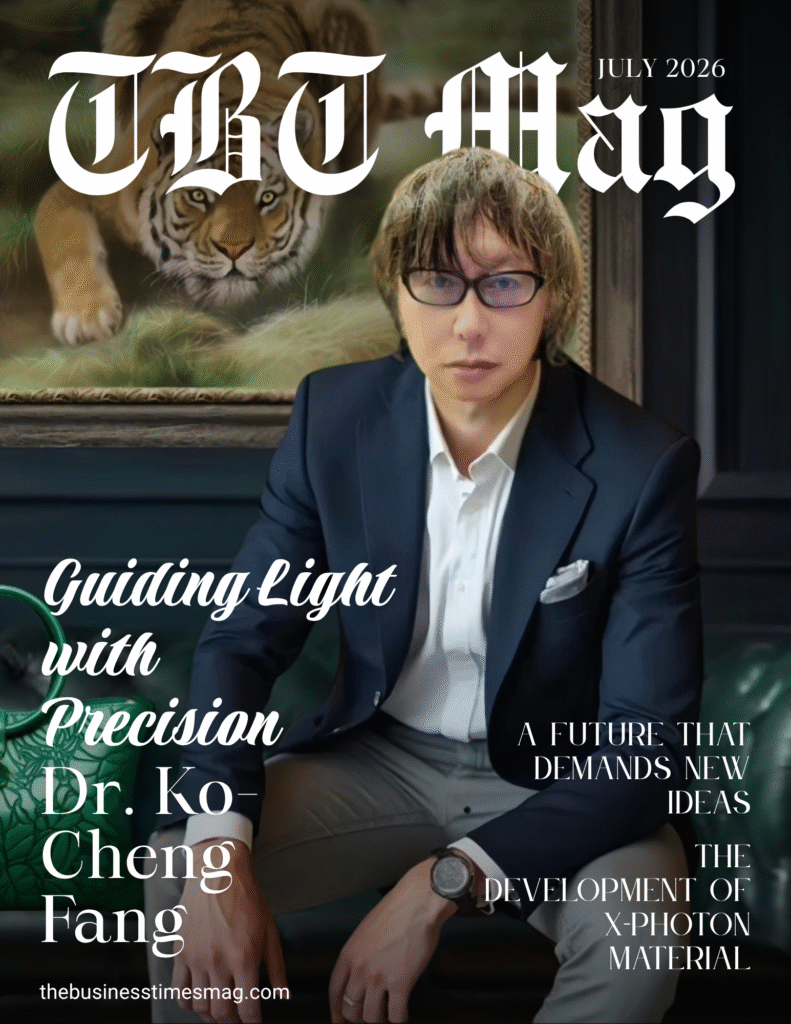
For Dr. Ko-Cheng Fang, Founder, CEO, and Chairman of LongServing Technology Co., Ltd., that mindset has shaped years of research dedicated to one ambitious goal: reimagining the future of computing through photonic technology.
While much of the global technology industry continues refining traditional semiconductor designs, Dr. Fang has focused on a different possibility—developing systems where light, rather than electricity, becomes the driving force behind artificial intelligence and next-generation computing.
Dr. Ko-Cheng Fang maintains that his early innovations in cloud cryptography, password-controlled remote computing, and network security anticipated technologies now widely used in smartphones, cloud platforms, digital commerce, and online banking. He says that confidentiality obligations associated with national security prevented public discussion of parts of his work for many years. Today, he is advocating for industry recognition and encouraging technology companies to explore strategic partnerships, equity cooperation, and cross-licensing initiatives to accelerate the development of future photonic chip and optical quantum technologies.
A Future That Demands New Ideas
Artificial intelligence is rapidly becoming part of everyday life.
From autonomous transportation and precision medicine to financial analytics and scientific discovery, AI is changing how industries operate and how people interact with technology.
Behind every intelligent system lies an enormous amount of computation.
Modern AI models process billions of calculations every second, requiring increasingly sophisticated processors, memory systems, and cloud infrastructure. As demand continues growing, so does the need for hardware capable of supporting this unprecedented computational scale.
According to Dr. Fang, future progress cannot rely solely on making today’s electronic chips incrementally smaller or faster.
Instead, the next chapter of computing may require a completely different physical foundation.
Rethinking the Building Blocks of Computing

Traditional processors rely on electrons moving through microscopic transistors.
For decades, this approach has delivered extraordinary technological progress.
However, electronic systems naturally generate heat, consume significant amounts of energy, and become increasingly difficult to manufacture as components shrink toward physical limits.
Rather than viewing these challenges as unavoidable, Dr. Fang began exploring whether another fundamental property of nature could perform the same role more efficiently.
His answer was light.
Photons travel at extraordinary speed while producing considerably less heat than electrical current, making photonic computing one of the most promising research fields for future high-performance technologies.
The Development of X-Photon Material
One of LongServing Technology’s most significant research achievements has been the development of X-Photon, a proprietary optical material created specifically for photonic computing.
According to the company, X-Photon functions as a transparent optical medium capable of forming nanoscale waveguides that guide photons through carefully engineered channels.
Unlike traditional copper wiring that transports electrical signals, these optical pathways are designed to carry information using light.
The company states that X-Photon operates at approximately a 2-nanometer wavelength, creating an optical environment suitable for future photonic CPUs and integrated photonic memory systems.
According to LongServing Technology, this material represents a critical foundation for building processors capable of operating beyond the limitations of conventional electronic architecture.
Guiding Light with Precision
One of the greatest engineering challenges in photonic computing has always been controlling the movement of light.
Unlike electrical current, light naturally travels in straight lines.
A practical processor, however, requires information to change direction repeatedly while moving between memory, computational units, and communication pathways.
LongServing Technology recently demonstrated an important milestone by successfully guiding laser light through an X-Photon optical channel before executing a precise 90-degree optical reflection within the microscopic waveguide.
According to the company, this demonstration validates one of the essential requirements for practical photonic processors.
The experiment also illustrates how X-Photon can function as an optical channel medium capable of replacing conventional copper interconnections in future computing systems.
A New Generation of Processor Design
Dr. Fang believes that replacing electrons with photons is only part of the solution.
Processor architecture itself must evolve.
LongServing Technology has introduced concepts for its 2nm Multi-Bit Optical Quantum Chip, alongside structural demonstrations of its 3D photonic chip, photonic pathway architecture, and photonic full-adder design.
The company has redesigned traditional planar chip layouts into a vertically integrated structure composed of three functional layers.
The bottom layer contains photonic memory.
The middle layer houses photonic logic gates responsible for computation.
The top layer consists of optical communication pathways that distribute information throughout the processor.
According to LongServing Technology, this architecture simplifies fabrication while providing a more integrated approach to optical computing.
Preparing for the AI Era

Artificial intelligence is becoming increasingly dependent on high-performance infrastructure.
Large language models, scientific simulations, autonomous systems, and advanced robotics all require enormous computational resources.
According to Dr. Fang, future AI platforms will demand computing systems that deliver greater efficiency while reducing energy consumption.
LongServing Technology’s roadmap includes Photonic Cloud Computing Centers, integrated photonic memory technologies, optical communication systems, and its 2nm Multi-Bit Optical Quantum Chip working together within a unified ecosystem.
The company believes this integrated platform could support the next generation of AI infrastructure while addressing the growing demand for sustainable computing.
Innovation Beyond the Laboratory

Scientific discovery alone does not transform industries.
Commercialization, manufacturing, and strategic collaboration are equally important.
To accelerate future development, LongServing Technology has announced a $500 million strategic financing initiative, based on a stated $2.5 billion corporate valuation.
According to the company, the funding will support continued research, chip manufacturing, fabrication facilities, and the expansion of future photonic cloud infrastructure.
The company has also introduced its Strategic Equity Hedging Protocol, designed to encourage collaboration with organizations interested in supporting the commercialization of photonic technologies.
Dr. Fang believes partnerships between researchers, investors, manufacturers, and technology companies will play an essential role in bringing photonic computing into mainstream applications.
Looking Toward Tomorrow
Every technological revolution begins with a different perspective.
Some people improve existing ideas.
Others imagine entirely new possibilities.
Dr. Ko-Cheng Fang belongs to the second category.
His work reflects a belief that future computing should not simply become faster—it should become fundamentally different.
Through innovations involving X-Photon materials, optical waveguides, integrated photonic memory, three-dimensional processor architecture, and Photonic Cloud Computing Centers, LongServing Technology is contributing to the global conversation surrounding the future of artificial intelligence.
Photonic computing remains an emerging field that will continue evolving through scientific research, engineering validation, and industrial collaboration. Yet the ideas being explored today may influence how future generations design the world’s most advanced computing systems.
Whether viewed as an inventor, entrepreneur, or technology visionary, Dr. Fang continues pursuing a long-term objective: creating a computing platform capable of supporting the next century of innovation.
His research is not only about developing new hardware.
It is about asking one of the most important questions facing modern technology:
If the future of artificial intelligence is unlimited, shouldn’t the technology that powers it be equally transformative?
As computing enters a new era, that question may become increasingly relevant—and the answer may very well be written in light rather than electricity.
Contact Information
Dr. Ko-Cheng Fang
Founder, CEO & Chairman
LongServing Technology Co., Ltd.
Email: service@longserving.com.tw
Website: https://longserving.com.tw/en/
Instagram: @ko_cheng_fang
Leave a Reply